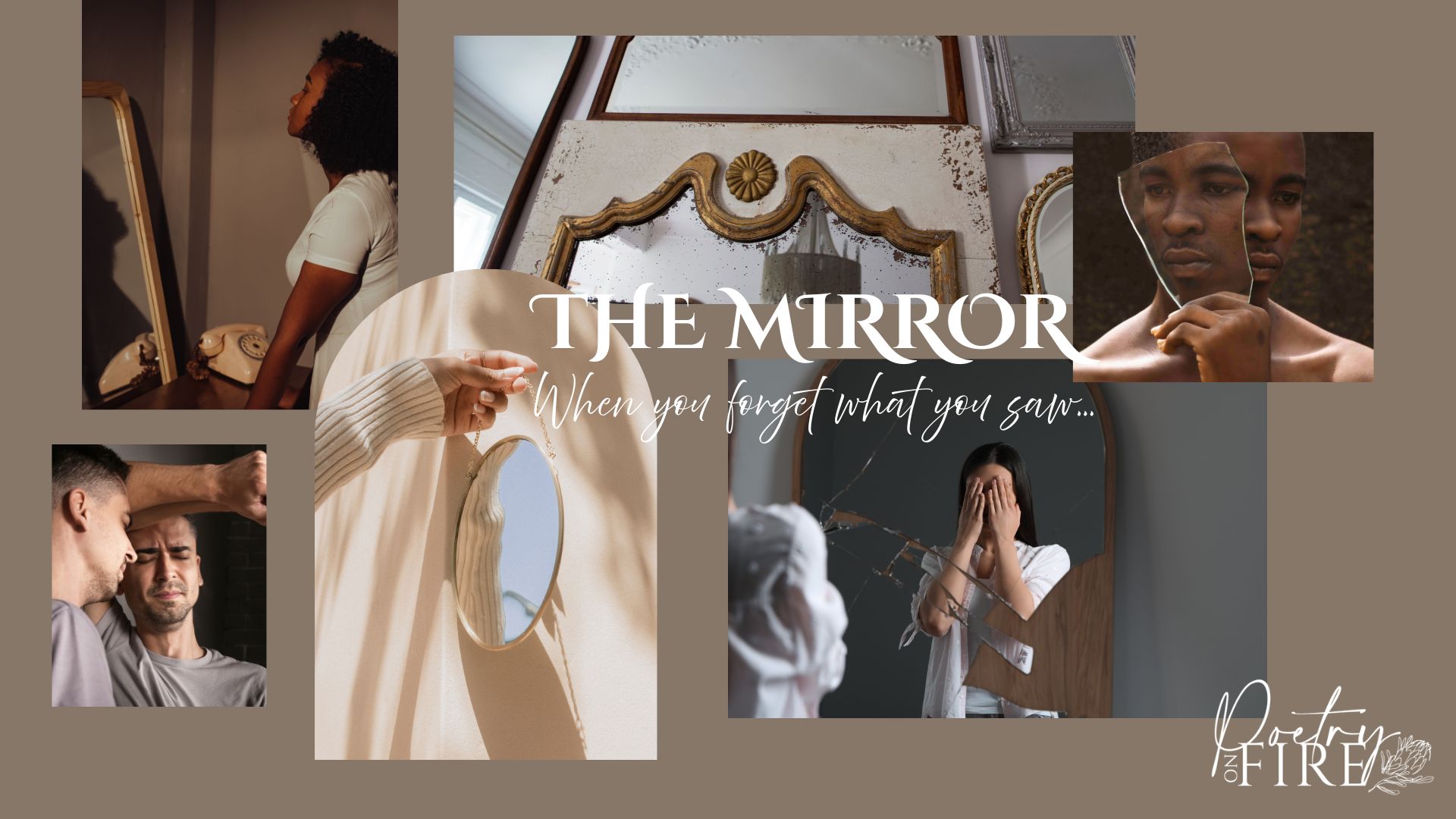
The distance between the mirror and the moment
There is a strange distance between the moment God shows us something and the moment we actually need it.
You read something in the morning that settles into you. It is not vague. It is specific. The Holy Spirit puts His finger on one thing, and you know exactly what He is speaking about. You close the Bible genuinely moved. You may even say out loud, “Lord, yes. I see it. I want to change here.”
And then somewhere between that chair and the rest of your day, that moment begins to disappear. Not because you rejected it. Not because you decided it did not matter. By ten o’clock somebody says something and the old reaction arrives before the memory does. By the afternoon you are handling a situation exactly the way you have always handled it. And later, perhaps while brushing your teeth, it comes back to you. That was the thing. That was the very thing He showed me this morning.
We have spent this series learning not to look away, learning not to stare only at the flaw, and learning to refuse the mirrors that flatter us. But there is a fourth thing James puts in front of us, and it is the one that quietens a room when you read it honestly.
The man in James 1 did not argue with the Mirror.
He forgot it.
Then HE ACTUALLY LOOKED PROPERLY
“For if anyone is a hearer of the Word and not a doer, he is like a man observing his natural face in a mirror; for he observes himself, goes away, and immediately forgets what kind of man he was.” (James 1:23–24 NKJV)
The word James uses for observing is katanoeō. It does not describe a careless glance. It carries the sense of looking at something attentively, perceiving it, considering it, taking it in. It is the same kind of looking Jesus speaks of when He tells us to consider the ravens and consider the lilies. It is thoughtful looking.
So, the man in this chapter is not a man who refused to look. He looked properly. He saw accurately. He understood what he was seeing. Whatever was there, he took it in.
The failure was never in the looking. It was in what happened after the looking.
That matters, because most of us have assumed the problem in this passage is a shallow person who could not be bothered with the Word. It is not. It is a person who read it, received it, felt it and understood it. They may even have been moved by it. And then life carried on, they day got busy, and that moment started leaving them…
This is confronting for those of us who love the Word. We can be people who read deeply, underline honestly, sit with a passage, weep over it, journal about it, and still be describing the very man James is warning us about. Depth of feeling at the mirror is not the same as change after it.
It is possible to be genuinely moved and still walk away entirely unchanged.
A HEARER OF FORGETFULNESS
James goes on to describe this person with a phrase that is striking in the original. In verse 25 he speaks of the one who is not “a forgetful hearer,” and what he literally writes is akroatēs epilēsmonēs, a hearer of forgetfulness.
The word for hearer, akroatēs, was used of somebody attending a lecture or a recital. A member of the audience. Somebody who is present, listening, taking it in, and who then goes home. There is no expectation that an audience member will do anything with what they heard. They came to listen. That was the arrangement.
And the word for forgetting, epilanthanomai, is not primarily about losing information from your memory. It carries the sense of neglecting, overlooking, allowing something to slip out of the place where it should have remained active.
Therefore, James is not describing a person with a poor memory. He is describing a person who has an audience relationship with the Word.
We were never called to attend the Word. We were called to live it.
And here is the kindness in it. Forgetting is not rebellion. It is a drift that we seldom realise is happening. Very few of us wake up and consciously decide to disobey what God showed us. What actually happens is far more ordinary than that. The message comes in. The child needs a lift. The meeting starts. Somebody sends something that irritates you. The pressure rises and the familiar response is faster than the new one. There was never a moment of defiance anywhere in it. The heart was never to return to old ways. It just…happened.
That is exactly why James addresses it. He is not warning us about the hardened. He is warning us about the sincere.
Most of what God shows us is not lost in rebellion. It is lost in a hurry, in busyness, in full calendars, and demanding relationships and lives.
THE ONE WHO STOOPS DOWN
Then James changes the picture completely.
“But he who looks into the perfect law of liberty and continues in it and is not a forgetful hearer but a doer of the work, this one will be blessed in what he does.” (James 1:25 NKJV)
The word for “looks into” is a different word altogether. It is parakuptō, and it means to stoop down and look closely into something. To bend over the edge of it. To put yourself in an awkward position so that you can see properly. It is not supposed to be comfortable. It ends up being confronting.
It is the word used of John at the tomb, when he stooped down and looked in and saw the linen cloths lying there. It is the word used of Mary, weeping, as she stooped down and looked into the tomb. It is even the word Peter uses when he says the angels desire to look into the things of the Gospel. A humility. A stooping down to get closer to the Truth…
Do you see the difference in posture? The first man stands in front of a mirror the way we all do, upright, comfortable, taking it in from where he already is. The second man bends down. He changes his position in order to see. There is effort in it, and there is a lowliness in it too. You cannot stoop and stay tall at the same time.
One man looked at the Word from where he was standing. The other bent his life around what he came to see.
And notice what he is stooping into. Not a list of rules. The perfect law of liberty. The Word does not bend down over us to trap us. We bend down over it to be set free. What we find when we stoop is not a verdict. It is an open tomb.
AND CONTINUES IN IT
Then comes the word that carries the whole weight of the verse. He looks into it and continues in it.
The Greek is paramenō, which is built from menō, to remain or abide, the same root Jesus uses in John 15 when He tells us to remain in the Vine. But para puts it alongside to remain. It means To remain beside. To stay next to something. To not leave its side.
We spoke in the second post about the branch that does not strive to produce fruit but simply stays connected. This is the same grace applied to the Mirror. The difference between the two men in James is not talent, discipline or spiritual seniority. One walked away from what he saw. The other stayed beside it.
Transformation is not usually a decision we make once. It is a decision we stay beside.
Staying beside it looks very ordinary. It looks like carrying one sentence of Scripture around with you for a week instead of reading forty new verses you will not remember by Thursday. It looks like praying about the same one thing on Wednesday that He showed you on Monday. It looks like returning to the same verse after you handled the moment badly, rather than avoiding the Mirror because you are embarrassed about what happened at three o’clock…
This is where I think many of us have been exceptionally hard on ourselves. We assume we are failing because we keep coming back to the same issue. Sometimes returning to the same issue is not failure at all. It is paramenō. It is remaining beside the thing God is busy with instead of moving on to something that feels like more exciting spiritual progress.
WHERE THE FORGETTING ACTUALLY HAPPENS
If we are honest about where the Word slips away from us, it is almost never in a dramatic place.
It is in the car. It is in the reply we type before we have finished reading the message. It is in the tone we use with the person we are most comfortable with. It is in the meeting where somebody takes credit for something, and we feel that old heat rise within. It is in the kitchen at the end of a long day when the last small request is one too many. It is in the conversation that turns towards a person we have opinions about, and we participate just enough to stay in the room.
The Word was not lost in any of those moments. The Word was simply not invited into them, because we had left it behind at the Mirror.
This is why James connects hearing and doing so tightly. The doing is not the proof that we heard. The doing is where the hearing was always going.
The Word does not become real at the Mirror. It becomes real in the three seconds before you respond.
REMEMBERING IS A PRACTICE, NOT A FEELING
So how do we become people who do not forget?
Not by trying to feel more strongly and stir up our emotions at the Mirror. Feelings fade by lunchtime and usually do. We remember the Mirror in the way people have always remembered anything that matters, by giving it a place to live.
Take one thing, not ten. You cannot remember ten things, and you were never asked to. What is the ONE thing He put His finger on in your life? Carry that ONE.
Say it out loud. There is a reason God told Israel to speak His words when they sat in their houses, walked by the way, lay down and rose up.
What we speak, we keep. What we only think about, we lose.
Write it where your day will find it – not where only your quiet time will find it. Your quiet time already knows. Put it where ten o’clock will find it.
Decide in advance what obedience looks like. This is the one most of us skip. If the Lord showed you that you become defensive when you are corrected, then decide now, in the calm, what you will do the next time you are corrected. You will say thank you before you say anything else. You will ask one question before you explain yourself. Decide it while you are still standing at the Mirror, because you might just not be able to decide it in the moment. And then receive His grace to follow-through.
Tell one trustworthy person. Not everybody. One person who loves Jesus and loves you enough to ask you about it next week.
And when you forget, and you will, come back. Do not treat the forgetting as evidence that nothing is changing. Treat it as the invitation to stay beside it a little longer.
Returning is not starting over. Returning is remaining.
THE DOER IS A POET
And now the part that I cannot read without something rising in me.
The word James uses for doer is poiētēs. It is the word for one who does, one who performs, one who carries something out. But in the Greek world it is also the ordinary word for a maker, a craftsman, a poet. It is the very word Paul uses in Athens when he says, “for in Him we live and move and have our being, as also some of your own poets have said.” (Acts 17:28 NKJV) Your own poiētai. Your own poets.
And when James promises that this person will be blessed in what he does, the phrase he writes is en tē poiēsei autou. Blessed in his doing. Blessed in his poiēsis. In his making.
James 1:22 is not merely telling us to be busy people who tick things off. It is telling us to become makers of the Word. To take what we have seen at the Mirror and let it be crafted into an actual life, in actual rooms, with actual people who did not deserve our patience on that particular morning…
This is exactly what The Passion Translation reaches for when it renders that verse, “always let His Word become like poetry written and fulfilled by your life.”
The doer is the poet. The one who forgets is the audience.
The Wildfire Co. has never been about beautiful words. It is about a life that became the poem, written and fulfilled by the Word of God.
The man who walked away from the Mirror still had the reflection. He simply never let it be written into anything. He heard the line and never lived the verse.
LIVING POETRY ON FIRE
This week, do not look for something new.
Go back to the one thing God has already shown you. Perhaps it came through this series. Perhaps He showed you what someone’s behaviour has produced in you. Perhaps He showed you that you have been staring at a flaw instead of beholding Jesus. Perhaps He showed you that you have been building an identity on flattering words. Perhaps He showed you something two months ago that you have not touched since.
Stoop down over that one thing again. Stay beside it.
Then do the practical work. Write it in one sentence, in your own words, as though you were explaining it to somebody you love. Decide in advance where it will be tested this week, because you probably already know exactly where. Decide in advance what obedience will look like when it is. Then pay attention when the moment arrives and choose the response that looks more like Jesus even while the old one still feels more natural.
And at the end of the week, ask yourself one honest question. Not “do I still agree with what God showed me?” You will always agree.
Ask: What did I actually do with it?
BE A WILDFIRE
There is something in this for the people around us too.
We live among many people who have heard an enormous amount and are exhausted from it. They have sat through the messages, saved the posts, attended the conferences and read the books, and somewhere underneath it all they are weary because none of it seems to have landed anywhere. That weariness is often not a hunger problem. It is a forgetting problem.
So be the kind of person who helps somebody remember.
When a friend tells you what God spoke to them, remember it with them. Ask about it three weeks later. Not as an inspector, but as somebody who genuinely wants to see what Jesus is making in them. Do you know how rare that is? Most people are never asked a second time about the thing that mattered most to them.
Celebrate the small doing. When you see somebody handle a situation differently to how they would have handled it last year, say so. That changed response cost them something in a moment nobody witnessed, and it deserves to be seen. A few days ago, one of my colleagues instinctively said: “Glory to God!” when he had a breakthrough in the project he was working on. Those are small moments, but they tend to become the big ones. Take note of it. Make them aware of it. And celebrate it with them, ensuring God gets the glory.
And when somebody comes back to the same struggle for the fourth time, do not sigh at them. Stay beside them. That is what paramenō looks like with skin on.
We do not need more people who can tell others what the Word says. We need more people whose lives make somebody else believe it is possible.
PRAYER
Father, thank You for Your Word that tells me the Truth and Your Spirit Who does not grow tired of reminding me. Forgive me for the many mornings I saw clearly and walked away unchanged. Not in rebellion, but in a hurry, in distraction, in the ordinary rush of my own life.
Teach me to stoop down. Take the upright, comfortable way I stand in front of Your Word and bend my life around what You show me. Give me the humility to stay beside one thing until You have finished with it, instead of running ahead to the next thing that feels like progress.
Holy Spirit, meet me in the three seconds before I respond. Bring what I saw this morning back to my mind in the moment it is needed, in the message, in the meeting, in the kitchen, in the conversation I should not be part of. And when I forget, draw me back without shame, because returning to You has never once been held against me.
Make me a doer of Your Word. Make my life the poem, written and fulfilled by Your Word. Let what You have shown me be written into how I speak, how I lead, how I forgive, how I love and how I remain, so that people do not simply hear about Jesus from me but encounter Him in the way I live. Only by Your grace, Lord. You deserve the glory always.
In Jesus’ Name, Amen.
We are His The Wildfire Co.. Let our lives become like poetry, written and fulfilled by His Word.
Jesus is the Only Name to Remember. Where Scripture burns. Where Truth Restores. Where hearts return Home.
Tell us, what is the one thing God has already shown you that you have not yet done anything with? You do not have to name it publicly if it is tender. But name it to Him today and then tell us what obedience is going to look like this week. Let us be people who remember together and remain beside.
Get Wildfire Word every weekday
The full Wildfire Word lands in inboxes at 07:00 every weekday, with the word study, the daily Walk the Word step and, on Fridays, a prayer and a question just for subscribers. Sign up free and receive our five-day guide, Intentionally Intimate, and the first pages of Choose Your Hard as welcome gifts.